Saturday, February 10, 2018

Party On Down, Cher!! Mardi Gras New Orleans Style


Mardi Gras
a celebration of excess New Orleans style 


Mardi Gras is French for Fat Tuesday.  It is the day before Ash Wednesday--when you give up luxuries for Lent.  Facing weeks of doing without the things they enjoy, people went on merrymaking binges, knowing they would have to remain in their homes and fast afterward.  Carnival is another word you see associated for the festive period.  It comes from Medieval Latin, meaning remove the meat.


While several places around the world celebrate Carnival, New Orleans is likely the best known.  The very first Mardi Gras celebration there took place in March 1699.  French explorers, Pierre Le Moyne d’Iberville and Sieur de Bienville, landed near what is known today as New Orleans.  Their party held a big celebration and christened the spot where they landed, calling it Pointe du Mardi Gras.


The King's Jester


Krewe Zulu Parade


The French settlers that followed celebrated the day with street parties, masquerade balls and lavish feasts.  However, when the Spanish took control of New Orleans, they were disgusted by the excesses, so they banned the celebrations and rituals.  This dictate remained until 1812 when Louisiana became a state.  In the late 1820s, groups of young men donned colorful costumes and paraded and danced through the streets.  The celebrations began to expand each year, until the first official Mardi Gras celebration was recorded about ten years later. 

The day is now a legal holiday in the state.


Krewe of Poseidon 

In the antebellum era of New Orleans the first Krewe was formed.  A Krewe is a secret society that sponsors a parade and ball.  The Mistick Krewe of Comus set the tone for all Mardi Gras celebrations thereafter.  Now there are many Krewes:   Poseidon, Rex, Orpheus, Bacchus, Endymion, Hermes, and Zulu are just a few-- so many their parades have to be on different days or times.


Bourbon Street

some parades are during the day, some at night

It's not advisable to wait to the last minute to go join the magnificent celebrations.  Finding rooms near is impossible, so plan ahead, book ahead!  Be sure to part take of a Poor Boy sandwich, Gumbo, Beignets, and especially don't miss having a big slice of King Cake.


Flameauxs


Krewe Leviathan 


King Cake and King Cake Donuts


Laissez Le Bon Temps Rouler

Remember Dawn on 10th Anniversary of her passing


We do not forget, Dawn.


Saturday, February 3, 2018

Wedding Excerpt - A RESTLESS KNIGHT, Dragons of Challon Book1


Dragons of Challon ™
Book One

As they rode out of the fortress, destined for the kirk, Tamlyn spotted a magpie landing on the open gate.  Her breath sucked in.  One magpie was a foretelling of sorrow.  She breathed again as a second one fluttered to sit by the first, then a third.  And fourth.  The presence of the birds caused the cold bile of unease to rise in the pit of her stomach.

Challon, riding at her side, noticed her dark mood.  “What brings forth such a scowl on this joyous morn, my lady?”

She glanced back to the birds, seeing three more had perched alongside the others.  “The birds.  ’Tis most peculiar for them to roost there.  Lore sayeth when they gather in numbers they are foretelling the future.  One means sorrow.  Two for mirth.  Three bring blessings for a wedding.  Four be an augury for a coming death.”  Her words died as the images of the nightmare flooded her mind.  Cold dread rushed through her being.

“Only blackbirds with white feathers, naught more, Tamlyn.  Likely, similar to the ones that haunt the passes.”

“Nay, those be ravens.  Magpies have the white markings and are smaller.”  She stared at the birds sitting in a row.  Their heads turned slowly, their eyes following her as she rode passed.

  Julian leaned over in the saddle and placed his hand over hers.  “’Tis seven birds only.  Mayhap, they heard tides the Dragon of Challon weds his beautiful betrothed this morn and wish to witness it.  What augury does seven magpies speak?”


“Seven herald a secret that must never be told,” she told him.  Unsure what they truly forewarned.  Did their presence warn her not to tell Challon of her dark dream, of things yet to come?  Would he even believe her if she warned him?  Oh, she wished she could speak to Evelynour.  She would ken their message.

He gave her a soft smile.  “Pay it no need, my lady.  I make my own luck.” 

They reined their horses before the church, and Moffet rushed forward to take the leads.  Pagan rubbed his muzzle against the mare’s neck, murmuring to her.  Challon lightly smacked the nose of the randy horse and pushed him back, so he could lift Tamlyn from the sidesaddle.

As Julian set her upon her feet, his eyes locked with hers.  The breathless moment spun out long threads, as he seemed to want to speak something of grave import.  Her heart swelled as she hoped he might finally say he loved her.  Instead, he placed a kiss to her cheek.  “You are beautiful.  A bride worthy of the Dragon of Challon.”

 When he saw she was still feeling skittish, his hand lightly circled the side of her neck and gave it a small squeeze.  Growing concerned, Challon looked down on her.  “Those birds?  They still bother you?”

“Unsettled me a wee bit,” she admitted.

A cloud passed through his dark green eyes.  “Be that all that distresses you?  Not having a second think on this marriage?”

She shook her head.  “Nay.  Truly that does no’ plague me.  As I spake before, ’tis the will of the Auld Ones.”

“I would wish for acceptance, not resignation.”  He took her hand and led her to the steps of the ancient kirk.  The throngs of people, lining both sides of the road, fell in behind them, following.  Malcolm, dressed in his robes of the Culdee, stood on the top step, waiting.

“We bid well-come to Tamlyn and Julian who have come to plight their troth...”

As her uncle began the ceremony, Tamlyn nervously glanced about her.  So many people had gathered to witness the union of the Chosen Daughter of Clan Ogilvie to the Black Dragon of Challon, their new lord.  Everything around her had a pall of unreality.  She trembled as she tried to concentrate on the faces of the people of Glen Shane.  Most were vague to her mind, as if she were having trouble focusing on their features.

Though she had convinced Challon there was no need to move the wedding date forward he had still insisted.  Through the Kenning she finally sensed he was simply eager for the ceremony to be done, to put a seal to their bonding.  She had asked him to learn to tolerate the ways of her people, so she had to accept his will as well.  They reached a compromise, and Malcolm agreed the wedding could take place within a sennight’s time.

 To her right, in a line behind Julian, stood his brothers, both dressed in the black livery of Challon. After them, came Baron St. Giles, though he wore ramients of greys.  ’Twas Clear to all the men bore the stamp of Challon.

The days passed in a flurry of activities.  With all the preparations, there was barely time to catch a breath.  Despite the hectic rush, concern over the continued absence of Lord Ravenhawke had cast a dark note.  Challon sent out riders in all directions, but none had seen the handsome black-haired man.  At Coinnleir Wood, her cousins admitted sharing a horn of mead with him, but had no idea where he could have gone.


Much to their surprise, early yestermorn, he had shown up at the gates of Glenrogha.  His clothing was neat, he was clean.  In spite of his pristine condition, he seemed disoriented.  When he finally was able to talk coherently, he spun a long tale about being taken and held captive by the Faery Queen.  Challon had laughed, thinking his cousin merely made up a story to cover his absence.  Tamlyn wondered.  All had heard how Thomas of Erceldoune was carried away by the Queen of Elfland, so many of Glenrogha’s people cast little doubt on Damian’s explanation.

The long, thick lashes lifted and Damian’s eyes collided with hers.  St. Giles’ eyes were green, a trait of Challon, but a grey-green, neither one color nor the other, yet both.  Their lightness was emphasized by the trappings of grey clothing he wrapped himself in.  The pale gaze seemed to look right through her.  The way he stared at her set Tamlyn to unease.  

Before Beltaine, he had watched her, but it was with a coveting, a sadness, knowing his feelings weren't returned and could never be.  Now...well, she was not sure what she saw in his eyes.  A question?  Only, Tamlyn had no idea what that question was.  Oddly, yestereve he had sought her out and declared himself her champion.  The avowal surprised her.  Emotions lived within him that had no right to exist.  His haunted eyes seemed to speak to her.  But what?  Regret?  Reassurance that all was for the best?  Envy?

Her questions were pushed aside, as Julian turned to follow the direction of her eyes.

Malcolm’s voice carried for all to hear.  “Therefore, if any man can show just cause why these two may not lawfully be joined together by God's Law and the Laws of the Realm, let him now speak, or else forevermore hold his peace.”

Julian lifted at warning brow at Damian, who had the grace to lower his eyes to the ground.  Turning back, Julian sent her a stare of reproach.  A proud man, he would not brook her looking upon another in favor.

At Julian’s silent admonishment, Tamlyn quailed inside.


Available in Kindle and Library Quality Print


#ScottishRomance #MedievalRomance #HistoricalRomance
#blogabookscene


Thursday, February 1, 2018

Greetings of the Festival of Imbolg


Beannachtaí na Féile Imbolc a Chairde
Greetings of the Festival of Imbolg

Imbolg or Candlemas Eve is a night that belongs to the goddess Brid or Bride.  In the old Celtic calendar it was the nocturnal welcoming of the first day of spring.  Small plants begin to bloom, and ewes start to lactate; the flowing of milk was viewed as the life-giving force returning to the land, finally the end of winter.  In old Scotland, the month of February fell in the middle of the period known as Faoilleach, the Wolf-month, for wolves were hungry, and still prowled the lower lands trying to survive.  Sometimes, it was called an Marbh-Mìos—the Dead-month, for leaves were not out yet, and things were still hard and cold.  Still, signs of new life were appearing.  Baby lambs come.  Soft rains sees the grass greening up.  Ravens and magpies begin to build nests, and start their fanciful dances of mating.  Meadow larks’ songs herald springtide across the glens.


blessing of the fields

I wrote about this ritual in RavenHawke, Book 2 of the Dragons of Challon, and in many areas remnants of this tradition are still carried out.  People would carry torches or large candles through the fields to purify them with the sacred smoke.  Once the parade was done, the remaining trash from the previous years crops was set aflame and the grasses were burnt to the dirt.  A ritual with purposeful meaning behind it.  The burning removed grass seed, and already rooted grass, which made the fields clear for plowing and planting.  Also, the trash becomes potash, which is fertilizer for the crops, producing stronger root systems and more abundant crops.  It also made them more able to withdraw periodic droughts.  Even today, I see people in the Southern US burn their yards down to the dirt, to reseed.  It gets rid of the weeds and the seeds that prove unwanted and makes for a dark lusher lawn.


alter of lights for Brid's Night

The lore says the old Lady of Winter, The Cailleach, is now being reborn as Brid, the Maid of Spring.  Brid is the light-bringer, she is tender, yet grows stronger as the sun’s time lengthens.  Brid’s name means exalted one.  Scottish artist, John Duncan, pictures her as young and fair, in his painting of Coming of Bride.  As with female deities in Scotland, she was a strong goddess, so rooted is her lore that you see the commonality of stories echoed through many countries in various similar names: Brid, Bride, Brigid, Bridget, Brighid or Brig.  In the 10th century, Cormac’s Glossary, she was described as the daughter of the Daghda, the Great God of the Tuatha de Danaan.  Brid is the personification of wisdom, a patron goddess of poets (poets covering bards).  Since the discipline of poetry, filidhect, was interwoven with seership, Brid was also seen as the goddess of inspiration, divination and prophecy.


welcoming of Bride's light

She was said to have two sisters:  Brid the Healer and Brid the Smith, but this is a repetitive theme of the Three Faces of the Goddess—the maid, the mother and the crone aspect of one single goddess, reflecting the wheel of life, death and rebirth.  Aside from the spiritual part of her nature, she was a patron of other worker crafts of early Celtic and Pictish society: dying, weaving and brewing.  A goddess of regeneration and abundance, she was greatly beloved as a provider of plenty, who brought forth the bounties of the natural world for the good of the people.  


Scottish Artist John Duncan's
"The Coming of Bride"
1917


Brid's Symbol hanging on ancient door

Beannaichte Latha Brid!!

Happy Brid's Day


Monday, January 22, 2018

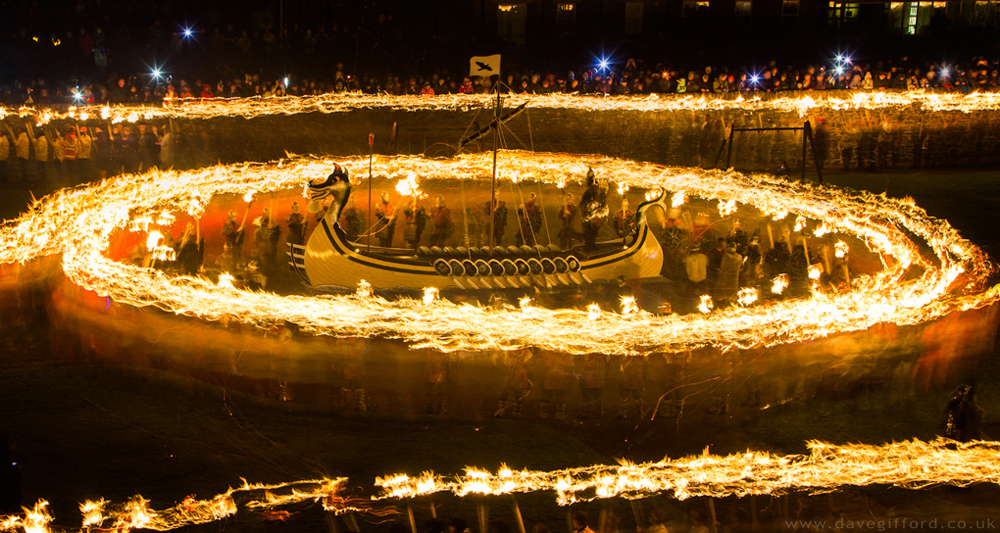
Up Helly Aa - the modern Viking fire festival with Pagan roots

Up Helly Aa

A New Age Viking-Scottish Tradition


Up Helly Aa  takes place in Lerwick, Shetland on the last Tuesday in January every year, with only breaks for the death of Queen Victoria (1901) the First and Second World Wars, and postponements for two weeks in 1900 for influenza outbreak and for the death of George V, and  one week for the death of Winston Churchill.
Though the festival has a very ancient Norse feeling, Up Helly Aa is a tradition that only originated in the 1880s. Since that time, the fire festival has been an annual event in the Shetlands.   The current festival held in Lerwick grew out of the older Yuletide tradition of Tar Barreling, which took place at Christmastime and New Year.   


Rowdy lads would drag barrels of burning tar through town on sledges and making mischief.  As this grew out-of-hand, the rites were abolished around the mid-1870s.  After a few years, people began to miss the festivity so they obtained permission to have a torch procession, the first one taking place in 1876.  


Soon, that was expanded into Up Helly Aa Day in 1881.  The first Viking galley was burned in 1889 at the end of the parade at the Market Cross.   Early Galleys were made from a light timber frame of discarded wood, and covered with canvas.  Modern Galleys are built and painted by local tradesmen.  Work starts at the end of October and continues two nights a week until completed.  


The torches in the parade are constructed from hessian sacks, with concrete “shoulders” to ensure they stay in place during the procession.  The Monday before Up Helly Aa, all the torches are soaked in fuel to ensure they burn well and last long.

Each year sees it grow in popularity.


Wednesday, January 17, 2018

Thinking Outside of the Box - Authors' Promotion 101


For years I've heard authors complain that nothing they do seems to improve their sales.  After thirteen years in the business, I have come to the conclusion no single thing will.  There is no magic biffity-boppity-boom and suddenly you are selling like hotcakes.  So what do you do?  Work.  Sorry, that is the raw truth.  Another sad truth?  Indy published, Small Press or Tradition published, it doesn't matter.  It's all going to fall on you.  Your money, your time.

Writing THE END is truly just the beginning of your journey as an author.  If you are a hobby writer (and I am not putting that path down) then marketing probably won’t be pressing for you.  But to the career writer, you must accept that you will likely spend as much time promoting as you do writing.  It’s a hard fact all new authors have to face.  There are days I do nothing but  promote...promote...promote.  It’s not fun, it’s grinding, and often you simply have no idea if any of it has impact.  So lose the idea I am going to offer you a golden key or a witch’s recipe to help you sell more books.  What I will do is impart some ideas to make you think about how you promote.  Most of this is old ground, but I continually see authors asking these same questions, even from authors a decade in the business...so one more time.

(Full Page Romantic Times ad 2009)

Paid Promotions —

There are various venues, which promote books for you.  I have gone that route with full page ads in The Romantic Times, Realm of Fantasy, and even history and Scottish magazines.  Did they help?  To this day I am not sure...lol.  Sad fact.  Actually, I did see heavy traffic to my website the day The Romantic Times came out.  So the ads I did with them drove traffic to my door.   

(Half Page Ad for Romatic Times 2007)

All my novels had high sell-through.  Sell-through is that point where your book begins to earn the publisher money, after all their expenses are covered.  My novels all have gone into third printings, and the Historicals are now in the fourth printings.  Was that because of the magazines ads?  I simply do not know.  Maybe.  Maybe not.  Frustrating, eh?  Maybe the ads were just a brick in the wall to building your brand.

As I said, most venues of PR leave authors scratching their heads.  So unless you have a $1000 or more to toss around you may not wish to consider this option.  If you do think you might want to opt for magazine ads, consider going in on ads with several authors—from the same publisher/ have the same subject matter.  I have done several of these.  Did they help?  Same redundant answer.  Possibly.

Positive side—you reach a lot of people all over the country.

Downside—high cost with no real assurance of a return.


(Double Page Ad in Realm of Fantasy Magazine 2009)

Reviews and Review sites—

There are a lot of places that offer reviews for free (NEVER pay for a review!).  Some also offer other author services, such as a web page on their site, or special showcase, chats, etc.  There have probably been fifty—maybe a hundred—over the last decade.  A lot didn't survive a year or two.  If you are looking into promotional packages with an author’s promo site, ask questions.  How much traffic do they have?  How will they promote you?  How often? 

Many have come and gone, but there are some solid ones that were there when I began and are still going strong.  Romance Junkies is one of the best.  Another top one is The Romance Studio.  I have done individual PR promos with them, but have also bought full service packages and have been very pleased with them.  Night Owl Romance is another I used and felt gave me plenty for my money.  As with print PR—be sure to weigh how much you are comfortable with spending for advertising.  Maniac Readers and Long and Short Reviews are two more I would recommend.  Two others I recommend that are more professional writing communities that let you promote all you need: Booktown and Authors Den.

Plus side—some of these venues have a big following, message board on Yahoo, website and social media presence.  Side Note:  Many of the social media pages are open to join free.  So check around.  You can find a lot of PR groups or pages on Facebook you can use.

Down side—they often are heavy with authors, too, so are not reader groups.  Meaning you are preaching to the choir.  Authors are there to promote their books, too, not buy yours.

Blogs and blogging—

Blogs were super hot ten years ago.  Now, everyone has them.  An author’s web site and blog are losing their importance in PR scheme of things.  Several reasons.  Most people seek out authors on spots like Authors Central on Amazon.com, or Facebook and Twitter.  These are updated frequently so they get fresh information and have a more personal feel.  Also, the average reader doesn't have time to read the blogs of 20-30 authors every week.  Generally, I use my blogger account as a personal showcase of what is happening in my life.  When I post about going to the Renfaire, or special restaurants or happenings in my town, I get as many if not more hits on those posts.  I give people a personal hello, what is happening, what books are out or coming.  I post excerpts or promotions.  Image intensive posts tend to get more attention.

Plus side—you can post daily where a website is more static.  You can get information out there quickly, run contests, and get PR rocking.

Downside—when you are doing frequent postings on a blog, requiring long articles, organized with images etc.—that is time away from your writing.  Since PR is already a big drain on your time, you have to make choices of what is more important.  Using your words takes those words away from your novels.  It has also been proven people respond to quicker, sharper posts, than long reading.  So keep that mind.


Social Media --

You might say well, duh.  Everyone knows about Facebook and Twitter.  So I won’t spend a lot of time pushing them.  But are you using Google Plus?  Google has groups and chat options, but I mainly use it as an information site, doing promos and such.  I often get more hits off postings there than either Facebook or Twitter.  Are you using Linkedin?  It’s less social and more business feel, but you can promote.  The neat thing about Linkedin is I can set it so my account reposts all my posts to Twitter—neat way to save a little time.

Right now my Linkedin account posts to Twitter.  My Blogger posts to Amazon Central, Booktown and Goodreads.  Twitter can be set up to post to MySpace and Facebook.  Word of warning--if you do that watch promo posting.  You are likely already posting to Facebook, but if you set up Twitter to post there too, you end up with double posts and someone will scream you are spamming everyone.  You can create a professional page on Facebook.  With a professional page you can add more people than you can on a personal page, and you can actually set your books up to sell right from the page.

Yahoo Groups—

they are showing some age after two decades and really no improvement for about ten years, but they still work to find reader groups and promo groups.  Again, you will run into the authors stampede, but you do what you can at times.  There are two means of posting—going to the individual group and posting on the message forum.  This is sent out to everyone on their list, and remains on the forum board.  Or you can be an mail box member—allowing you to post and reply through your own email, but if you chose this option you cannot post on the forum boards.  If you join at the Yahoo Groups site itself, you will have both options available.

Authors Central on Amazon.com—

They provide you free of charge an author’s page.  You can load about half a dozen photos, bio information, and set up your book list.  You use their claiming option to claim your books, and they will place them on your page, so when a reader checks in, they will have every thing about you in one spot.


Book signings—

Book signing are another option.  Personally, I do not enjoy them, but I know many people who love doing them.  The downside is getting people into the bookstore (which requires PR to do!)  Unless you or the store promotes the event, don’t expect a line like Stephen King gets.  You might try to organize a multiple author signing.  That tends to be a bit more fun.  Also, check and see if you have any big book fairs near you.  Don’t just offer to do a book signing at the local bookstore.  Offer to give a master class in romance writing, or how to realistically write a specific time period.  This will draw people in that are interested in learning to be a writer.  

But all these options are in the box thinking, and by my title I said we would be thinking out of the box.  Here is where you have to put your thinking cap on and see what venues are out there where you could do signings.


What events are happening in your area?  A farmer's market?  A craft fair?  Small shop Saturdays or events around holidays?  See if your local tea room might want to have a book signing.  Your local library branch?  You might combine it with a talk on how to get into publishing, or something along those lines.  One I have suggested to Historical writers—Renfaires.  There is a natural target.  They are into history, reenacting, costumes—you have someone who speaks your language.  I once discussed this targeting your audience, and Jacquie Rogers decided to go after rodeos, which is perfect for Western writers.  So is your county fair.  Many offer booth space for very a reasonable price, and often can do multiple days.  


One of the best book signings I did was at Keepers Seafood and More, just outside of my town.  I went there expecting not to sell a book.  I was totally surprised, selling hundreds of dollars of books in just three hours.  


The point being, you simply don’t know what will work until you give it a try.  You could organize a book launch party.  Tea rooms or cafés are a great place to hold a launch party.  Have a sheet cake and several pots of tea or punch, and invite people in to help you celebrate.

Craft fairs are another place.  These tend to pop up around late autumn and holidays.  They are generally merchandise orientated, but most are very open to you having a booth to promote your books.  Splurge on Vista Print poster—sometimes you can get them for $10 or less.  So far, I haven’t found authors going in this direction so you generally have a good showcase.  Books, especially, sell well around Christmas, since they make great presents.

Getting your name out there— 

Not just as you are a romance writer—get you name into various other venues.  There are a wide variety of options.  Some might even pay you.  Consider penning an article for a magazine.  Today it is easy enough to check out magazines on-line.  Writer’s Digest accepts articles.  But don’t just focus on  romance writing venues.  Pen a short story for Alfred Hitchcock Magazine or Ellery Queen Magazine for example.  By getting into a different genre you widen your exposure.  Look at area magazines.  There can be a wide range of different focuses, from ones covering a whole area such as Southern Writers Magazine, to others more localized.  There is a monthly magazine that covers my county.  Maybe you have a historical society that puts out monthly pamphlets.  Consider doing an article for your local newspaper.  Consider doing seasonal recipe story about what people ate then and include recipes.  Same for Western writer – especially good in the summer—Cowboy tips to open-fire cooking.  Look for a fashion angle.  See if you can tie in your period clothing to an article about women’s changing fashions.  These are just a few suggestions to help you think outside the box.  Getting your name—your brand—out there can be done outside of the normal perimeters of fiction writing.  Check out the magazines or news sites you haunt next time.  See what submissions they accept, how to submit.


(Romantic Times Half Page Ad - February 2007, shared with Cynthia Breeding)

Bottom line, it’s ALL work.  Sorry, there is no way around it.  Writing The End isn’t the end of your dream.  You have birthed you baby, now you must continually feed and nurture, and like all children they require a balanced diet.

Several bestselling authors I know were not big overnight successes.  It took years for them to sell.  Years to build an audience.  Most will tell you without a strong backlist they would have never made it to the top.  That means never stop promoting all your novels, stories and novellas.  Keep your works in print so the readers can find you.

Selling takes three things 1) talent/skill.  Talent you are born with.  Skill can be learnt.  Never stop honing your craft.  2) Opportunity, being at the right spot at the right time.  An editor may want a Scottish novel now, but two weeks from now the door has closed.  3) Determination—it’s grinding work, but if you don’t do it, what happens?—generally nothing.  Marketing is not hard, it’s persistence and time.  It takes a bit of imagination.  Don’t look at other authors and say, “What are they doing?”  Ask instead, “What they not doing?”

Don’t be afraid to try some PR venues that haven't been done before.  You just might surprise yourself.